
We typically get two reactions when we tell people we homeschool year-round. First, there’s a gasp of horror and then there’s a follow up, “Oh my! I could never – WHY?”
Even in the homeschooling community, there’s a lot of misunderstanding about what year-round schooling looks like, and for good reason, since a ground of year-rounders could each be doing something different. Most year-round homeschoolers that I’ve met are still following some type of schedule. There’s still a first day and last day of school, but the summer break is much shorter than a traditional school schedule (1 month or less in my experience). However, there are a few of us that are homeschooling in a non-scheduled way. On paper there may be a beginning and ending of a school year for record keeping purposes, but school continues on every single day, allowing natural breaks to happen as needed.
Before you keep reading, please know that I am not suggesting that every single person should follow a year-round schedule. Homeschooling is about doing what’s best for your child and family. If a traditional schedule works for you, or something like a 6 weeks on 1 off schedule, then stick with it! You don’t have to reinvent the wheel every year or constantly try something new. Find what works and let it work for you. BUT if you are looking for something else because you need change or because your new to homeschooling and exploring your options, then keep reading.
We chose to year-round school for a couple of reasons. First, our kids were ahead in their schooling. We knew they were ready to move on to tougher topics, but they were not ready to sit still for longer periods of time; their attention spans were too short to be years ahead in school. Year-round schooling allowed us to take curriculum meant for those older grades and break them up into shorter lessons each day.
Second, I really needed the routine. When we first started homeschooling, I was working from home. I needed our days to look exactly the same Monday through Friday to give myself a consistent workflow and to give my kids a set expectation for the day. Taking long breaks over the summer would not have worked for us at all.
So, what does your schedule look like? Our days are relatively short; most days are under 2 hours total. (**Our kids are in early elementary and lower. We expect we may get up to 4-hour days as they get older, so if you have older children adjust your expectations accordingly.) Here’s a glimpse at what our day looks like:
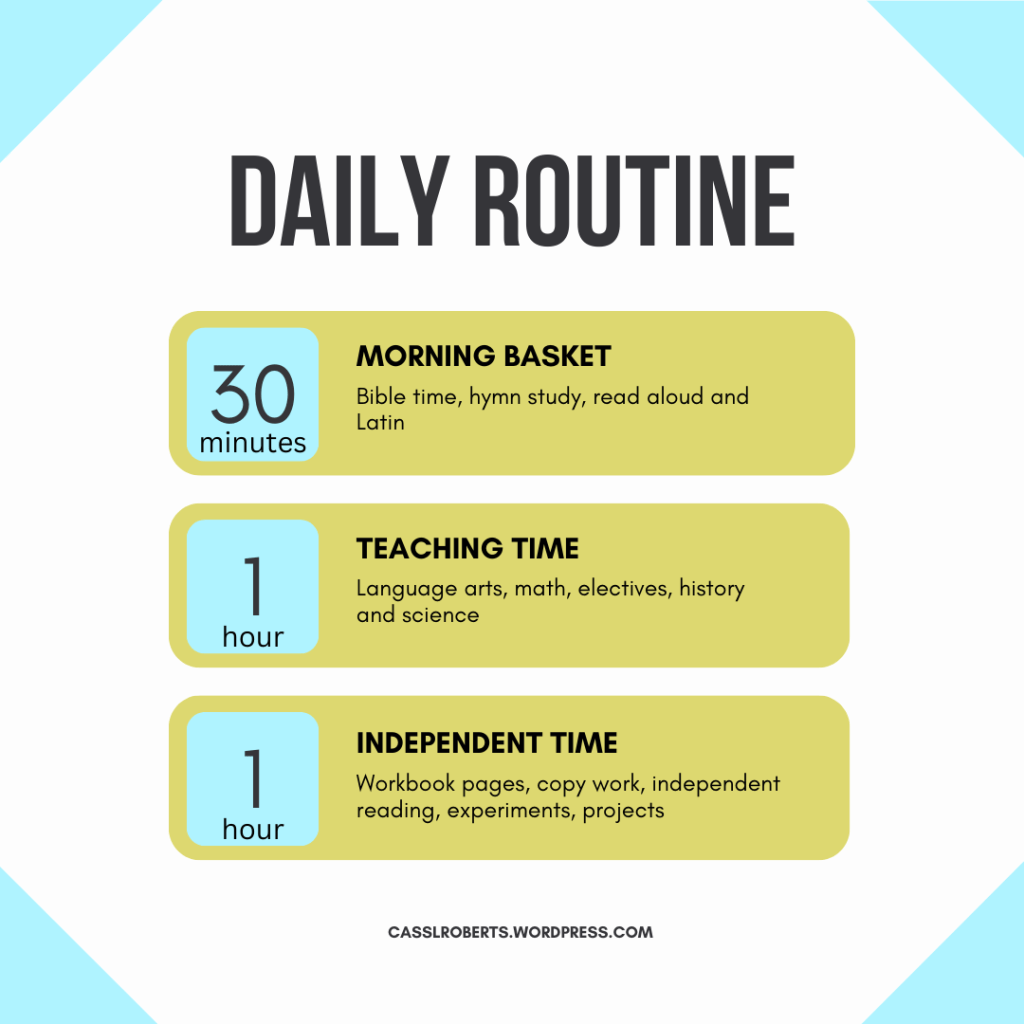
You’ll see there are three main blocks: Morning basket, teaching time and independent time.
Morning basket for us right now includes Bible time (lesson, memory verse and prayer time), a hymn study, a read aloud and Latin. None of the things in morning basket will be tested over. I want it to be a time of non-pressured learning and hope that one day when they’re adults they will mimic this style of learning on their own.
Teaching time is exactly what it sounds like. Anything that I need to actually teach or review is covered during this time. Flash cards, new concepts, oral math practice, history, science, music theory – all of it. And yes, it only takes us about an hour right now. I expect that time to increase as they get older. Teaching time covers language arts and math along with our electives (which are on a loop) and history or science (we alternate each day).
Independent work is all of the paperwork, projects and experiments. My kids love doing their papers, so we use workbook heavy curriculums. If your kids do not like paperwork, then this time may be filled with things like reading or documentaries. Though it says “independent”, I’m still available to help with these, especially for my younger child, who cannot read the instructions on her papers. The long-term goal though is that these things become independently done.
What about start dates? On paper, our school year starts on September 1st (or the first week-day in September; our county does not allow weekend starts). In all practicality, we don’t have a start date. To give an example of how this works, let’s say we started homeschooling on September 1st using the schedule above. We finished with our science curriculum on March 1st. We do not wait until the next school year to start the next curriculum. Instead, we start the new curriculum on the next science day. When we finish language arts, let’s say May 1st for our example, we will immediately begin the next language arts curriculum. Same for math, history and all of those electives. We do not wait until a schedule says we can start. We just jump in to the next level of learning.
Won’t you get too ahead? Since we’re homeschooling, I’m never really too concerned about being “too ahead”. After all, ahead of whom? The learning standards set by our local public schools that aren’t keeping up with national or global standards? Yeah, I’m okay with being ahead of those 😉 In reality, we are never really too far ahead of what I had planned. I often take more complex lessons and break them up over multiple days to keep our learning time short and focused. Or if a child is struggling to understand something, we may work in multiple days of review and reinforcement before moving on to the next lesson. It evens out over the course of a year.
What about breaks? Like I mentioned in the beginning, we take breaks as needed when they naturally occur. All of our family lives in other states. When they come see us, I want my kids to be able to soak up all of that time with them. We will take the entire week off to do that. We take breaks whenever someone is sick, without worrying about catching up to make up for those days missed. We also take off time for holidays as needed. I work in retail now, so I’m always working through the Thanksgiving and Christmas seasons. There is no reason for us to take a full week or two off around these holidays. Instead, we will take the holiday itself off, and see what opportunities open up for us to squeeze in some family time. If we manage to all be off for the Monday before Christmas and can make some family memories? Then yeah! We will absolutely take the day off to do something together.
I think it’s important for kids to see that life goes on. That memories can be made even in the daily routines. I know for me, it was such a shock after college to suddenly work a job that didn’t have 2 months off in the summer and 2-4 weeks off at the holiday season, plus a spring break, fall break, etc. I began living for the weekends and those 2 weeks of vacation, which is no way to live. I want my kids to see that the ‘mundane’ can still be a great life.
Do your kids hate not having a summer break? This question is one I often get asked, and I’m not sure there is a fair answer here. My kids have never had a summer break. They don’t fully understand what it means to go weeks without doing school – they cannot imagine what it’s like. My older child has school aged friends who take summer breaks, so she’s starting to ask questions about things like this. She asked me if the kids just stayed home with their parents and read books from the library instead of doing workbooks. And while I’m sure there are some children who do read all summer (hooray for the bookworms!), I think her reasoning here shows what I mean. She thinks learning each day is normal and cannot imagine long stretches without it. She cannot imagine a true summer break.

And there you have it! Our year-round schooling “schedule”. I hope this gives you some inspiration and maybe a new perspective on scheduling options. If you have any questions, drop them in the comments below and I would be happy to help as best as I can. Happy homeschooling!

 Cassie at Home
Leave a comment